Product Prioritization: Build Trust, Remove Blockers, Create Value
A new capability looks compelling in a demo. A reliability fix does not. Private connectivity, audit logs, and deployment automation rarely make exciting launch headlines. Yet these less visible investments can determine whether customers can use the product at all.
After more than a decade in product management and engineering, my perspective is this: prioritization is not about building the most features. It is about choosing the investments that make the product valuable, trustworthy, and usable for the customers we intend to serve.
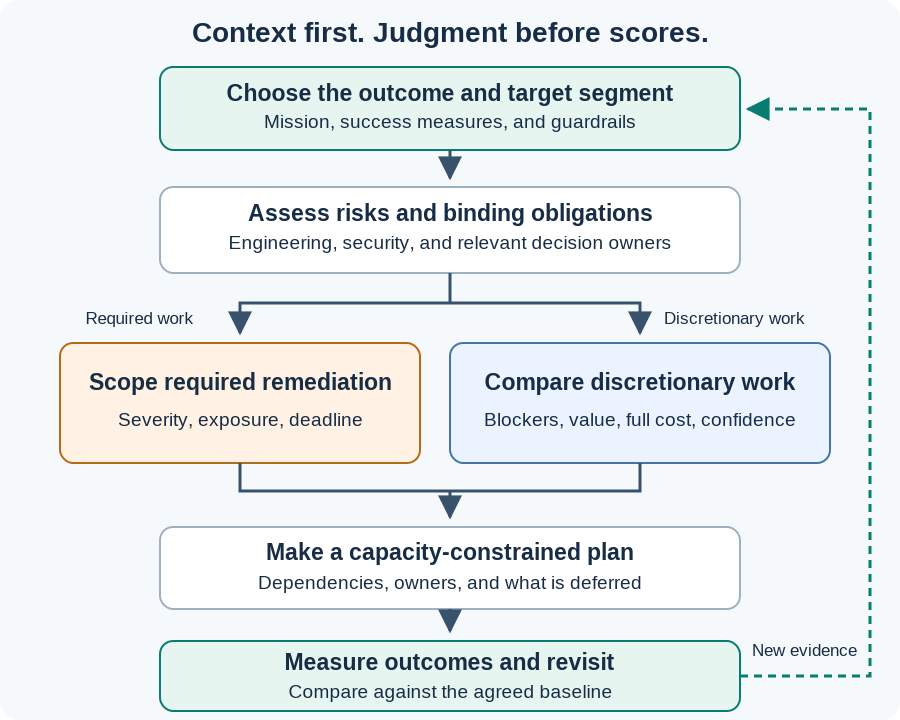
For enterprise and consumer products, the workflow is: set an outcome, assess obligations and blockers, compare value and cost, commit within capacity, then measure and revisit. All scenarios are hypothetical, not accounts of specific customers, employers, or measured results.
1. Start with the mission, then choose the outcome
A mission provides direction; a planning objective defines progress now. Without that link, almost any feature can be called strategic.
I start with three questions:
- What customer problem does the company or team exist to solve?
- Which customer segment and business outcome matter most in this planning period?
- What must remain true while we pursue that outcome?
The third question defines guardrails: boundaries that prevent progress on one metric from damaging something important, such as reliability, security, customer satisfaction, or cost.
For an enterprise analytics product, “ship another dashboard” is an output. “More qualified pilots reach a defined production milestone” is an outcome.
Different contexts lead to different investments:
| Current objective | Investments worth investigating |
|---|---|
| Find product-market fit | Validate the core problem, improve first-use success, test demand |
| Increase enterprise adoption | Resolve verified deployment, security, and governance barriers |
| Improve retention | Address workflow failures, reliability gaps, and unmet recurring needs |
| Improve profitability | Reduce cost per successful workload and avoid unnecessary operating complexity |
These are starting hypotheses, not automatic rankings. A startup still needs appropriate security; an enterprise platform still needs differentiated value.
Understand the problem before comparing solutions. A request for another setting might mean customers need predictable performance, which better defaults could provide. Teresa Torres’s opportunity solution trees connect outcomes, customer needs, solutions, and assumption tests.
The diagram maps the decision loop. Select it to open the full-size version.
2. Protect product trust before adding marginal capability
I give material quality, reliability, and security problems priority over discretionary feature additions. But these terms describe different failures:
- Quality: the product does the right thing, including correct results and usable workflows.
- Reliability: it does that consistently under expected operating conditions.
- Security: identities, systems, and data are protected against unauthorized access or misuse.
The distinction matters. A service can be available and still return incorrect results. A feature can work correctly and still expose data to the wrong user.
With engineering, security, operations, and relevant legal or compliance owners, agree the minimum bar: unacceptable harm, applicable obligations, and remediation severity and timing. A high feature score cannot waive a binding requirement. NIST’s Cybersecurity Framework and organizational profiles offer a structured way to compare current and desired security outcomes.
For reliability, a service-level objective (SLO) is a target for a customer-relevant measure, such as the share of successful operations over a defined period. An error budget represents the failures permitted by that target. An agreed policy can direct effort toward reliability when the budget is exhausted. Google’s example error-budget policy illustrates this mechanism; adapt its thresholds. Security obligations and data correctness are not risks to spend through an availability error budget.
Not every bug outranks every feature. A cosmetic defect may wait; recurring failures that break important workflows may not. Depending on severity and capacity, remediation might interrupt feature work, narrow a launch, or run in parallel.
The goal is an appropriate trust bar, not an endless pursuit of perfection before innovation.
3. Treat verified adoption blockers as multipliers
A missing capability can block access to everything already built. Removing it may matter more than adding value for existing users.
I distinguish three situations:
- Adoption blocker: the target customer cannot begin meaningful use.
- Expansion blocker: the customer can use the product but cannot extend it to the intended scale or workflow.
- Improvement: use is possible, but slower, harder, or less satisfying than it should be.
These are situations, not permanent priority levels. Severe friction can matter greatly; unblocking a segment outside the strategy may have limited value.
Before accepting “we need this to adopt,” validate:
- Which specific workflow, policy, or technical requirement prevents adoption?
- Who confirms the requirement, and which other target customers share it?
- Is there an acceptable, secure workaround?
- What else would still prevent deployment, purchase, or expansion?
- What concrete next step will the customer take if the barrier is removed?
Evidence might include failed deployment evaluations, purchasing requirements, or repeated findings across qualified opportunities. A feature request alone is weaker evidence.
For consumer apps, investigate abandonment during sign-up or the first meaningful task. Combine usage data, interviews, and usability tests: drop-offs do not explain why people leave. Check device, accessibility, and connection constraints before proposing features.
Removing one blocker is necessary, not necessarily sufficient, for adoption. Pricing, procurement, migration effort, or another missing capability may still stand in the way. Do not count the full value of a prospective contract as guaranteed revenue from one feature, or attribute the same deal independently to every prerequisite.
4. For enterprise products, operability is part of the product
An enterprise does not buy only a user experience. It must also be able to secure, govern, integrate, deploy, and operate the product.
These can be the verified adoption blockers from Section 3. Plan them as product work, not as miscellaneous requests addressed only after a sales escalation.
| Readiness dimension | What customers may need | Question to validate |
|---|---|---|
| Identity and access | Single sign-on (SSO), role-based access control (RBAC), workload identities | Can people and applications use the product with appropriate permissions? |
| Network and data protection | Private connectivity, traffic controls, encryption, residency options | Can this deployment satisfy the customer’s actual security and data policies? |
| Governance | Audit logs, administrative policies, retention controls | Can administrators understand and control how the product is used? |
| Delivery and integration, including CI/CD | Supported APIs, automated testing, environment promotion, infrastructure as code | Can the product fit the customer’s change-management workflow? |
| Reliability and recovery | Monitoring, diagnostics, tested recovery procedures | Can the customer operate and recover the intended workload? |
| Scale and cost | Capacity limits, workload isolation, usage and cost visibility | Can the customer grow usage predictably without unacceptable interference or cost? |
CI/CD means continuous integration and continuous delivery: automated validation and repeatable delivery, not necessarily deployment without approval. Supported automation and safe environment promotion may be adoption requirements, not merely engineering conveniences.
Microsoft’s security checklist and safe-deployment guidance provide Azure-oriented design guidance, not a universal list of required controls.
Match readiness to the target industry, geography, workload, and customer policy. Private connectivity does not by itself make a product secure, and one governance feature does not establish regulatory compliance.
5. Use Pareto analysis without surrendering the roadmap
The Pareto principle, or 80/20 rule, highlights concentration: a small group of contributors may account for a large share of an outcome. Juran’s guide explains how to identify these “vital few” using observed data.
Perhaps 80% of revenue comes from 20% of customers. Investigate; do not assume that split. Rank accounts by revenue over a defined period, calculate cumulative shares, and compare segments and time windows. Apply the same analysis to support burden by failure category or operating cost by workload.
A renewal-critical request from a major account deserves attention. But revenue concentration is also a business risk, not a reason to give a few customers permanent roadmap control.
I examine five things together: revenue at risk, renewal timing, strategic fit, applicability to other customers, and lifetime ownership cost. Distinguish observed revenue from forecast opportunities, and assess how confidently the request is linked to the commercial decision.
A reusable governance capability may protect a major account while serving the broader segment. A bespoke approval workflow for that account alone might still be justified, but needs an explicit commercial case, support model, and boundary against product fragmentation.
Customer count alone can undervalue enterprise needs. Revenue alone can undervalue the next market you want to serve. Use both, alongside strategic fit and evidence.
For a consumer subscription product, compare free and paying users, new and returning users, and device groups. High spenders are not necessarily representative of the intended audience. Free users may become subscribers or contribute value to others. Validate those effects; do not assume free users are equally valuable or worthless.
6. Use scores within an investment strategy, not instead of one
Once required work and strategic context are clear, scoring can help compare discretionary opportunities. I use it to expose assumptions, not to manufacture certainty.
Use RICE for comparable opportunities
Intercom’s RICE framework combines four inputs:
- Reach: affected customers or events within a defined period.
- Impact: expected benefit per affected customer or event.
- Confidence: how strongly evidence supports the estimates.
- Effort: estimated team time required.
RICE = (Reach x Impact x Confidence) / Effort
Use consistent reach units and time windows, an impact scale tied to the same outcome, and evidence behind confidence estimates. A confidence score is not a calibrated probability that a revenue forecast will come true. Intercom also explicitly recognizes that dependencies and customer prerequisites can justify working out of score order.
Avoid one formula for everything. A short-term activation experiment and a multi-year platform investment have different horizons and evidence. Discuss how much capacity should go toward adoption, innovation, product trust, platform health, and learning. There is no universal allocation percentage. Required remediation must not be capped by a convenient portfolio quota.
Account for value, full cost, and timing
Compare marginal value: what the next investment adds after costs, over the same horizon. Revenue is not equivalent to the same amount of cost savings: serving it also costs money. Make ongoing costs and uncertainty explicit.
Count design, development, integration, testing, documentation, support, operations, maintenance, and eventual migration or retirement. “Two days to build” does not mean two days to own.
Translate technical debt into consequences: customer failures, cost per successful workload, recovery effort, or slower delivery of strategic work. Conversely, do not fund a refactor solely because the architecture could be cleaner.
Cost of delay is the benefit lost or extra cost incurred by waiting. A renewal window can make an investment time-critical even when another has greater total value. Check feasible delivery dates first: urgency does not make an impossible deadline achievable. See SAFe’s sequencing guidance for deeper treatment.
Sequence dependencies explicitly. The highest-value feature might need a lower-visibility foundation first. Sometimes the better investment is simplifying or retiring a costly capability, with impact analysis, a supported alternative, and a credible migration path.
7. Apply the decisions to enterprise and consumer products
Enterprise: adoption versus a time-critical renewal
An enterprise analytics product aims to move qualified pilots into production. Customer-impacting job failures are breaching an agreed reliability threshold, and multiple qualified pilots have verified private-connectivity requirements.
Assume capacity for two scoped investments this cycle. Engineering has sized a reliability fix and a private-connectivity slice, including dependencies, testing, and operational readiness. Other access, governance, and deployment controls are adequate for these pilots.
| Candidate | Reasoning in this context | Initial decision |
|---|---|---|
| Address recurring job failures | The current trust bar is breached; adding capabilities does not repair unreliable workflows | Fund the scoped remediation |
| Enable required private connectivity | A verified barrier blocks the target pilots from production | Fund the validated adoption slice |
| Add an AI-assisted analysis feature | Potential differentiation, but evidence does not yet show it advances this cycle’s outcome | Defer implementation; identify the assumption to test |
| Add a bespoke integration for a major account | Commercial importance is plausible, but renewal dependence and broader applicability are unclear | Validate before committing |
| Improve infrastructure efficiency | Potential cost reduction; urgency and savings need workload evidence | Revisit with a measured business case |
Then the evidence changes. Validation shows the integration is renewal-critical, deliverable before the deadline, and fits the second slot. After costs and uncertainty over the same horizon, its expected incremental benefit exceeds the value lost by delaying pilots, whose plans can wait one cycle.
Keep the reliability fix, replace connectivity with the integration, and delay the pilots one cycle. Agree this retention exception with the decision owner: it delays the adoption goal.
Budget discovery too; a “quick win” is not a free third initiative. If the deadline is infeasible, investigate smaller scope or an acceptable alternative rather than promising to rescue the renewal. Reassess if reliability meets the agreed bar or connectivity does not unlock the pilots.
Consumer: first value versus more engagement
A reading app wants more new readers to complete a first reading session and return the following week. Assume the team has capacity for a scoped crash fix and one bounded experiment. Crash reports show an agreed reliability threshold is breached on supported low-memory phones; usability tests suggest mandatory interest selection prevents some readers from reaching an article.
| Candidate | Decision under these assumptions |
|---|---|
| Fix crashes on affected phones | Fund the remediation; more content does not repair a broken reading experience |
| Let readers skip interest selection | Test whether this improves first-session completion without hurting next-week return |
| Add reading streaks and more notifications | Defer implementation; evidence has not established that reminders address the underlying problem |
Test the onboarding change against the current flow in a randomized experiment where practical. Define the target improvement and evaluation window before launch. Check results by device group, with crash rates, privacy choices, and notification opt-outs as guardrails. More opens or time in the app alone would not demonstrate reader value.
If completion improves but return weakens, investigate content relevance before declaring success. If onboarding already works, better discovery or useful reminders may deserve priority. Neither consumer growth nor enterprise adoption automatically outranks trust or retention.
8. Make the decision durable, then close the loop
Product brings problems and value hypotheses; engineering brings scope, dependencies, and lifecycle cost. Security, operations, and compliance owners validate risks and obligations; sales and customer success bring commercial evidence. Agree final decision authority and how disagreements escalate.
Use this lightweight decision record for each substantial commitment:
- Outcome and target segment: What change are we trying to create, and for whom?
- Problem and evidence: What is observed, estimated, or still assumed?
- Risk and timing: What requires action, who validates it, and by when?
- Options and investment: What alternatives, dependencies, and full ownership costs were considered?
- Decision and owner: What is funded, and who is accountable?
- Opportunity cost: What will wait, and why?
- Success and guardrails: What baseline, target, customer group, evaluation window, and guardrails will we use?
- Review trigger: Which date or new evidence would justify reconsideration?
A stakeholder response can be specific without being dismissive:
“We’re keeping the reliability fix and choosing the validated, renewal-critical integration over connectivity. With the decision owner’s agreement, pilots move one cycle later. We’ll revisit if the delivery forecast or pilot timing changes.”
After delivery, check outcomes, not only completion. Did affected customers experience fewer failures? Did eligible pilots reach production? Did cost per successful workload fall without increasing failures or breaking compatibility? Compare against the agreed baseline and account for changes in customer or workload mix; a before-and-after improvement alone does not establish causation.
Review new evidence at an agreed cadence. Severe incidents or time-critical obligations may warrant immediate intervention; louder requests usually do not. Reprioritization creates interruption and unfinished work.
For the delivery side of this loop, see Agile and Scrum for Product Managers.
The question to take into your next planning meeting
Instead of asking only “What should we build next?”, ask:
“What most prevents our target customers from realizing value, and what are we willing to delay to address it?”
Sometimes the answer is a new capability. Sometimes it is reliability, security, enterprise readiness, or a simpler product. Good prioritization makes that choice explainable, funds it realistically, and checks whether it worked.
References and further reading
Start with outcome framing and concentration, then use the operational guidance and scoring framework to deepen the decisions relevant to your product.
- Teresa Torres / Product Talk: Opportunity Solution Trees. Connects business outcomes, customer needs, solutions, and assumption tests. Useful before turning feature requests into investment proposals.
- Juran Institute: Pareto Principle and Pareto Analysis. Explains concentration and ranked contribution analysis. Use your own revenue or problem data rather than assuming an exact 80/20 split.
- NIST: Cybersecurity Framework 2.0 and Organizational Profiles. The profile resources support comparison of current and target security outcomes. They inform risk planning, not a feature-score waiver.
- Google SRE Workbook: Example Error Budget Policy. Shows how reliability evidence can redirect work toward remediation. Adapt the policy to your service and customers; do not copy its example thresholds blindly.
- Microsoft Azure Well-Architected: Security Checklist and Safe Deployment Practices. Concrete guidance on access, networks, protection, and controlled releases. Useful context for enterprise readiness, not a universal procurement checklist.
- Sean McBride / Intercom: RICE Prioritization. Defines reach, impact, confidence, and effort, including reasons to work out of score order. Use it for transparent comparisons within an explicit investment strategy.
- SAFe: Weighted Shortest Job First. Optional depth on sequencing using cost of delay and job duration. The timing principle is useful without adopting another scoring process.
Note: This blog post was written with assistance from AI