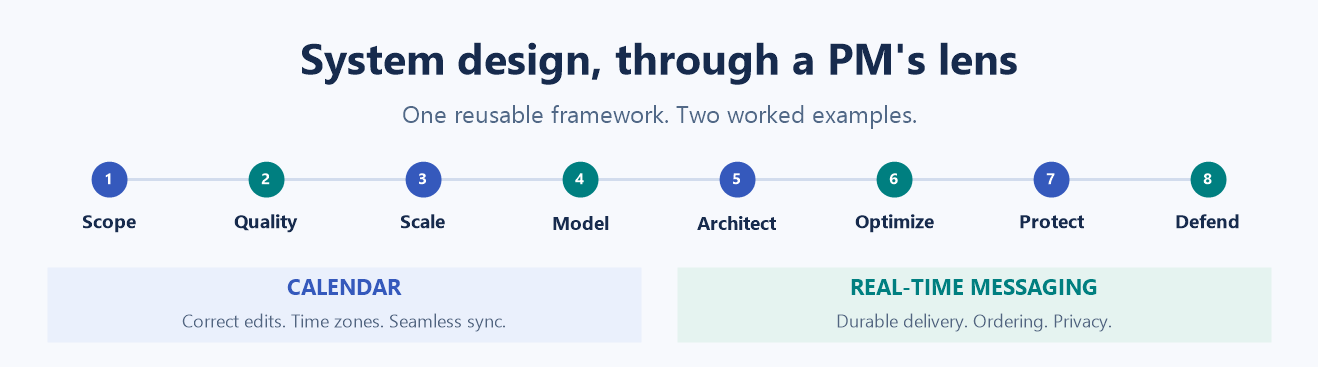
System Design for Product Managers: A Framework You Can Defend
System design connects a user experience to the components, data, and operating rules needed to deliver it. Product managers need not choose every engineering detail, but should explain what must work, what must stay correct, what can fail, and what it costs.
We will follow two examples throughout:
- Calendar: Maya schedules a weekly meeting with Leo, changes it, and expects their calendars and reminders to agree.
- Messaging: Maya sends Leo a message while his phone is offline, then wants to know whether it was accepted, delivered, or read.
The framework also applies to commerce, payments, collaboration, analytics, and other systems, with different workloads and correctness rules. Follow the foundations and diagrams if new; use Decision depth sections to challenge familiar assumptions.
The designs resemble Google Calendar and WhatsApp workflows; they do not describe those products’ private infrastructure. All scale numbers, targets, and retention policies are illustrative. Named technologies are candidates, not interchangeable guarantees.
The reusable eight-phase framework
Phases guide decisions; layers implement them. A database is a layer, but deciding what it must preserve spans several phases.
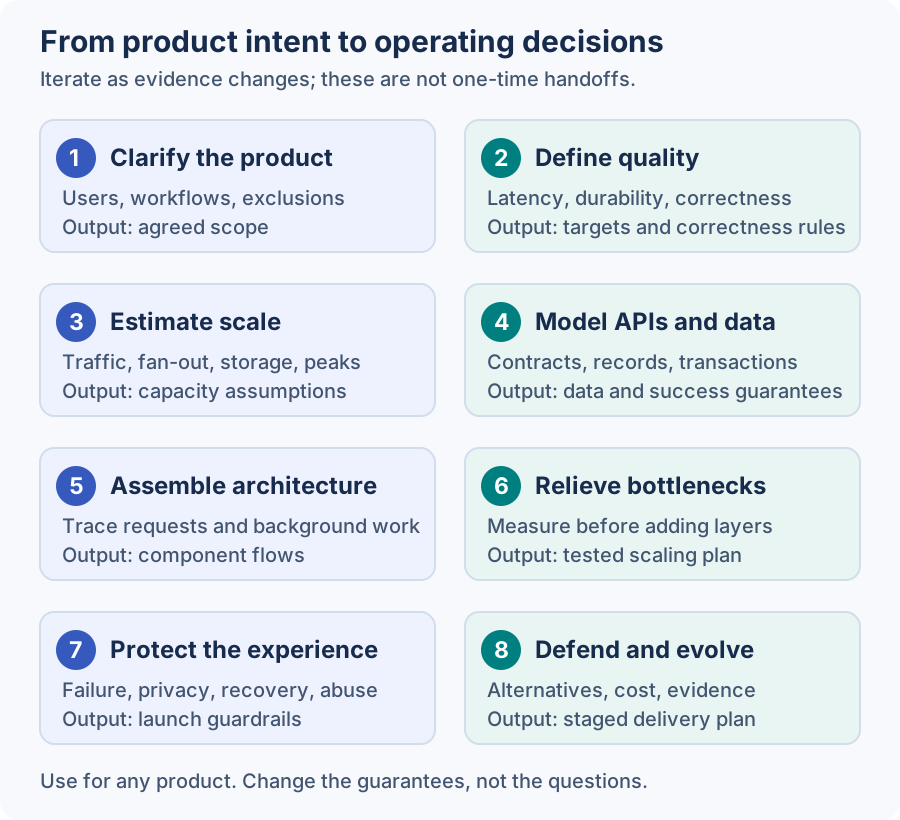
Jump to: 1. Scope · 2. Quality · 3. Scale · 4. APIs and data · 5. Architecture · 6. Bottlenecks · 7. Failure and trust · 8. Evolution.
This is an iterative framework, not a waterfall. A privacy requirement can change the data model; a recovery requirement can change latency and cost.
First, understand the smallest working system
A client (browser/mobile app) sends a request to a backend, which checks permissions, applies rules, accesses a database, and responds. The database holds shared, durable state: data intended to survive a process restart.
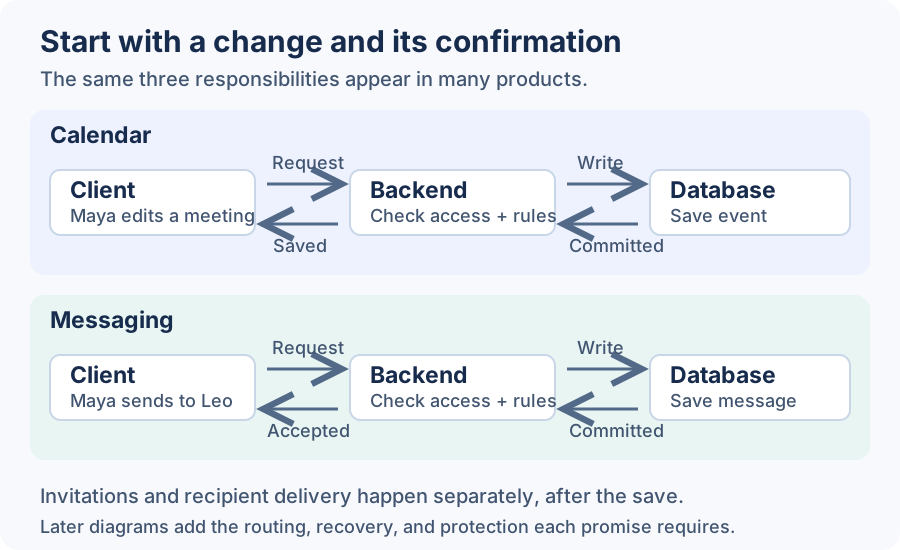
Authoritative state settles what is true. Maya’s local Calendar edit is not yet a confirmed shared event; her pending message does not prove server acceptance.
The response waits for synchronous work, not for asynchronous work such as invitations or delivery attempts. Background work can race with the response; independence, not wall-clock order, is the distinction.
Phase 1: Clarify the product
Define users, three to five workflows, exclusions, and limits. Personal agendas, medical appointments, and exclusive room booking require different rules despite all using calendars.
Record the budget, deadline, existing infrastructure, team operating capacity, and data-location obligations. A Calendar team reusing enterprise identity and a messaging team without round-the-clock operations may choose differently despite similar traffic.
| Scope | Calendar example | Messaging example |
|---|---|---|
| Core workflows | Create/edit/cancel; invite and RSVP; recurring events; reminders; device sync | One-to-one and small-group text; offline delivery; linked-device sync; read receipts |
| Required protections | Calendar roles, including free/busy-only access | End-to-end encryption (E2EE) and device revocation |
| Optional behavior | Availability suggestions | Presence and typing indicators |
| Exclusions | Video calls, payments, automatic room allocation | Voice/video calls, public channels, payments |
| Limits to decide | Date-range size, attendee count, recurrence expansion | Group size, message size, linked devices, pending-message retention |
Decision depth: distinguish a suggestion from a reservation. A personal calendar may allow overlapping meetings. A cached “free” result is a suggestion, not a guaranteed room booking. Likewise, “online” is a hint, not proof a person can receive a message. Define the promise before choosing the mechanism.
Output: agreed workflows, exclusions, limits, and owners for unresolved decisions.
Phase 2: Define quality and correctness
Latency is how long an operation takes; throughput is work completed per unit of time. Availability measures successful service; durability concerns preserving committed data. A system can respond quickly and still lose the user’s work.
A service-level indicator (SLI) is a measurement; an SLO is its target; an SLA is a contractual commitment. p95 below 300 ms means at least 95% of measured operations finish within 300 ms; p99 describes the 99th percentile.
| Requirement | Calendar example | Messaging example |
|---|---|---|
| Availability | 99.95% monthly success for eligible core API requests | 99.95% monthly acceptance success for eligible submissions |
| Latency | p95 range fetch below 300 ms; p99 save below 500 ms, at the regional API boundary | p99 acceptance below 500 ms at that boundary; p95 delivery below 300 ms for the connected cohort |
| Correctness | Do not silently overwrite a newer meeting edit | A retry must not create another visible message |
| Freshness | Own confirmed edits visible immediately; 99% of edits applied on other connected devices within 5 seconds | Conversation order converges; presence may lag |
| Durability | Confirmed saves survive the specified single-zone failure | Accepted, unexpired pending messages survive that same failure model |
These are illustrative targets. Eligible means authorized, well-formed, and within
published quotas: exclude expected validation rejections, but count capacity-induced
failures, including overload 429s. Define the connected delivery cohort at submission:
authenticated foreground devices with active channels in the serving region. Keep later
disconnects and missing acknowledgments visible as failures, not retroactive exclusions.
An invariant is a rule that must remain true: only authorized people can read an event; only authorized devices receive new message content. Unlike a latency target, violating such a rule is not an acceptable routine error budget.
Decision depth: measure the promise, not the convenient denominator. Excluding undelivered messages from delivery-latency charts can hide failure. Pair latency with delivery success and oldest pending work. A 99.95% time-based target allows 21.6 minutes in a 30-day month; that is not interchangeable with a request-based error budget. If Calendar misses its freshness target over a 15-minute window, investigate and pause rollout.
Output: measurable targets, correctness rules, and explicit degraded behavior.
Phase 3: Estimate scale
The figures below are a growth stress test, not the MVP’s claimed capacity. Start from measured launch demand; use the larger workload to expose future bottlenecks.
Estimate only what changes a decision. Average operations/second equals daily operations divided by 86,400; multiply by an assumed peak factor for an initial peak estimate. Fan-out means one action creates work for several recipients: attendee updates for Calendar, recipient-device deliveries for messaging.
| Assumption or estimate | Calendar example | Messaging example |
|---|---|---|
| Daily active users | 20 million | 100 million |
| Actions per user/day | 20 reads; 2 mutations | 40 submitted messages |
| Daily traffic | 400 million reads; 40 million mutations | 4 billion submissions |
| Average operations/second | About 4,630 reads; 463 mutations | About 46,296 submissions |
| Assumed peak | 4x: about 18,520 reads and 1,852 mutations/second | 3x: about 138,889 submissions/second |
| Additional delivery work | Multiply edits by affected attendees | 3 device attempts/message: about 416,667 attempts/second at peak, before retries |
| At 1 KB per change/message | 40 GB/day of changes, not net live-event growth | 4 TB/day logical ingress; 120 TB if all copies remain for 30 days |
Endpoint counts are not database-query counts: a Calendar range can span calendars; one message can require multiple encrypted device envelopes.
Deleting delivered copies reduces the 120 TB retention bound; three replicas raise it to 360 TB before indexes, backups, device expansion, or overhead. At the assumed, unmeasured 1 KB size, peak ingress is roughly 139 MB/second before overhead; fan-out adds outbound bandwidth.
Decision depth: count quiet users too. Ten million live connections at a hypothetical, load-tested 50,000 per gateway require at least 200 gateways before spare capacity. Heartbeats every 30 seconds produce roughly 333,333 signals/second without a single new message. Calendar sync polling can similarly dominate traffic between edits.
Output: a capacity worksheet with units, peak assumptions, and measurements to validate.
Phase 4: Design contracts and data
Choose how components communicate
An API (application programming interface) specifies operations, inputs, outputs, and errors. HTTP provides request/response semantics; HTTPS protects HTTP using Transport Layer Security (TLS). Neither proves a write was saved.
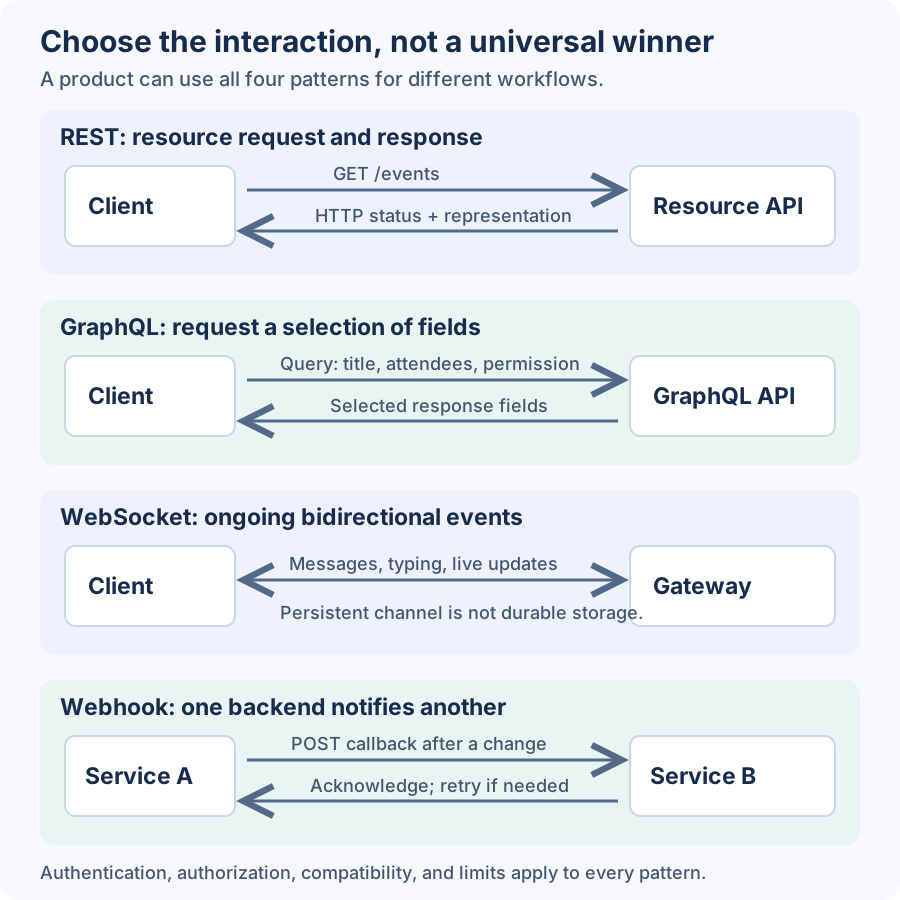
| Pattern | Meaning | Calendar application | Messaging application |
|---|---|---|---|
| REST | Resource-oriented API using HTTP semantics | GET events, POST a new event, PATCH an edit |
Manage conversations, groups, and devices |
| GraphQL | Request selected fields through a typed schema | Event title, attendee responses, and permissions in one query | Conversation membership and device metadata; optional, not needed for live delivery |
| WebSockets | Persistent, bidirectional client/server channel | Live edit notifications where useful | Messages, receipts, and typing updates |
| Webhooks | One backend calls another after an event | Notify an authorized calendar integration of a change | Optional delivery-status integration, with explicit consent and no plaintext leakage |
Long polling and server-sent events remain alternatives when their interaction model fits. Implementation options appear in the technology reference.
Authentication establishes who the caller is; authorization determines what that caller may do. N+1 reads means one list query followed by one query per item, in REST or GraphQL implementations. Batch related reads and limit query complexity. Authenticate webhook senders, deduplicate retries, and retrieve current state when notifications are hints.
Model relationships and access patterns
An entity has an identity. A primary key uniquely identifies a record; a foreign key references another key and can enforce valid relationships in a relational database. Calendar has calendars, events, attendees, and permissions. Messaging has conversations, memberships, devices, messages, and delivery receipts.
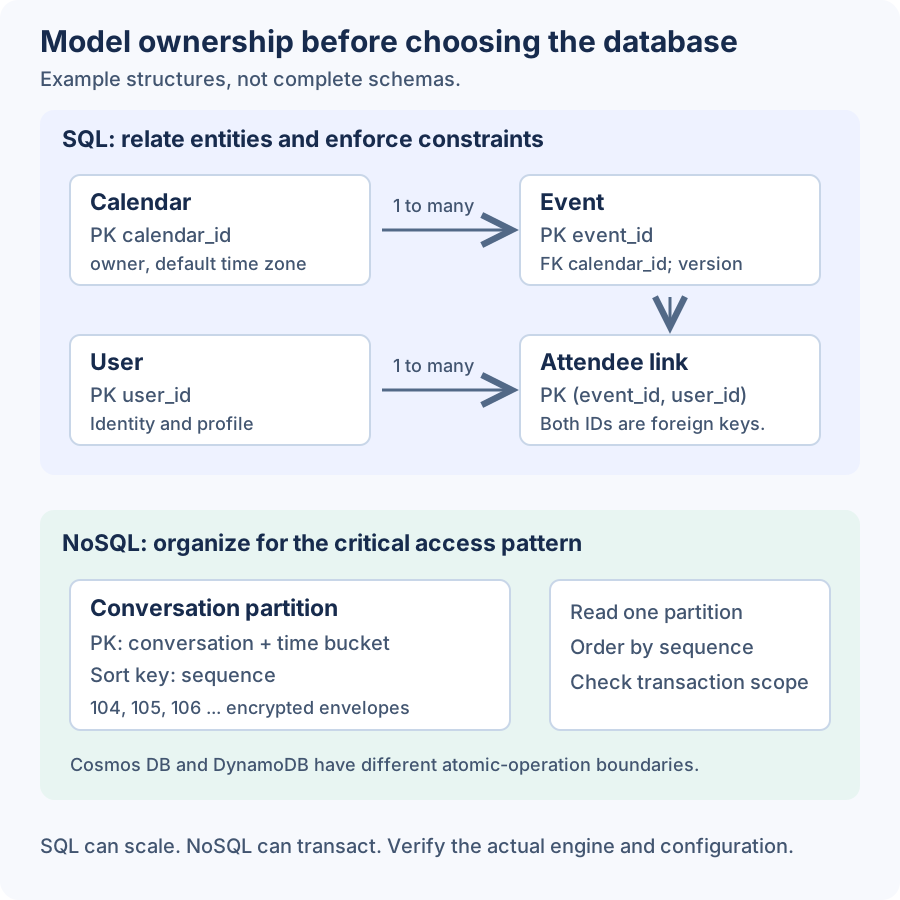
SQL (Structured Query Language) databases, such as Azure SQL Database and PostgreSQL, fit related records, joins, constraints, and transactions. NoSQL includes document, key-value, and wide-column models; Azure Cosmos DB and Amazon DynamoDB are examples. SQL can scale; NoSQL can transact. Verify schemas, keys, consistency, and operating limits.
- Calendar: an event references its calendar;
(event_id, attendee_id)uniquely identifies an invitation. The organizer controls shared time, title, and cancellation, and may grant editing rights. Each attendee controls their RSVP, visibility preferences, and personal reminders. Store these authoritative records separately from derived agenda views. Leo’s stale view cannot override Maya’s cancellation; a late RSVP cannot revive it. - Messaging: retrieve pending messages by conversation and sequence; find a retry’s saved result by sender device and stable client message ID. Keep delivery receipts separate from disposable “which gateway is this device using?” hints.
PostgreSQL can launch either example; justify partitioned NoSQL through measured needs.
Define what a successful write means
A transaction groups database operations. Atomicity means all changes commit together or none do; idempotency means repeating the same logical operation does not repeat its effect. Neither implies the other.
- Calendar: atomically commit the event, required related records, and operation result.
Use stable idempotency keys for both creation and edits. For a new edit, send the version
read using
If-Match; reject a stale version with412 Precondition Failed. - Messaging: persist the encrypted message (ciphertext), its sequence, and retry result before returning accepted. The sender reuses the same client message ID; recipients also deduplicate. A socket receiving bytes is not durable acceptance.
Scope idempotency keys to the caller and operation, bind them to a request fingerprint, and define retention. A fingerprint detects reuse of the key with different content. After the supported retry window, require reconciliation or rejection.
Lost-response example: Maya edits version 7 with key K; version 8 commits, but the
response disappears. On retry, recheck authorization, then return K’s stored result if its
fingerprint matches, before evaluating the now-stale If-Match: 7. A different operation
using version 7 still conflicts. Check and commit retry identity atomically with the edit.
For our one-to-one messaging contract, pending is unconfirmed local work; accepted is durable server commitment; delivered means at least one authorized recipient device acknowledged storing the message locally; read is a client-reported state subject to privacy settings. Failed means a definitive rejection, not a transient timeout. Expired/unconfirmed means no recipient acknowledgment arrived before the retention deadline; delivery attempts stop, but this does not prove a device never received it. Groups need per-member receipt aggregation rather than reusing the one-to-one badge.
Preserve domain meaning, not just bytes
Calendar: 9 a.m. every Monday in Los Angeles is not “add seven days in UTC.” Store local
time, an IANA time-zone identifier such as America/Los_Angeles, the recurrence rule, and
occurrence exceptions. Define daylight-saving ambiguity, use dates for all-day events,
and expand only a bounded time window. “This occurrence,” “the series,” and “this and
following” are different edits; the last may split a series. Specify how that split maps
exceptions, preserves or resets attendee responses, and cancels/reschedules reminders.
Messaging: choose ordering within a conversation, not across the whole product. A server-assigned sequence records acceptance order, not the order people typed on unsynchronized clocks. Device history and server retention differ. Our example retains each authorized device’s pending envelope until its acknowledgment, revocation, or a 30-day expiry. Leo’s laptop acknowledgment changes Maya’s badge to delivered and makes that copy deletable; his offline phone’s copy remains pending. Its later expiry does not undo the delivered badge. New-device history transfer is a separate authorized feature. Later device revocation or local corruption does not erase historical acknowledgment: delivery is not a permanent-storage or backup guarantee.
Decision depth: transaction scope is an architectural constraint. DynamoDB can atomically update distinct items across tables within one account and Region, with documented size/count limits. Cosmos DB transactional batches require the same logical partition within one container. Foreign keys likewise do not automatically enforce relationships across independently owned services or shards.
Output: API guarantees, entities, access patterns, and transaction boundaries.
Phase 5: Assemble the architecture
Add routing and policy around the basic request
An IP address identifies a network endpoint; a port identifies a service endpoint there. DNS resolves a service name into records used to reach it. DNS is a lookup, not a proxy through which every request passes; cached answers also delay routing changes.
A forward proxy acts for clients, such as a corporate outbound proxy. A reverse proxy fronts servers. A load balancer distributes traffic among healthy instances; an API gateway applies shared authentication, quotas, and routing policy. These responsibilities can share infrastructure.
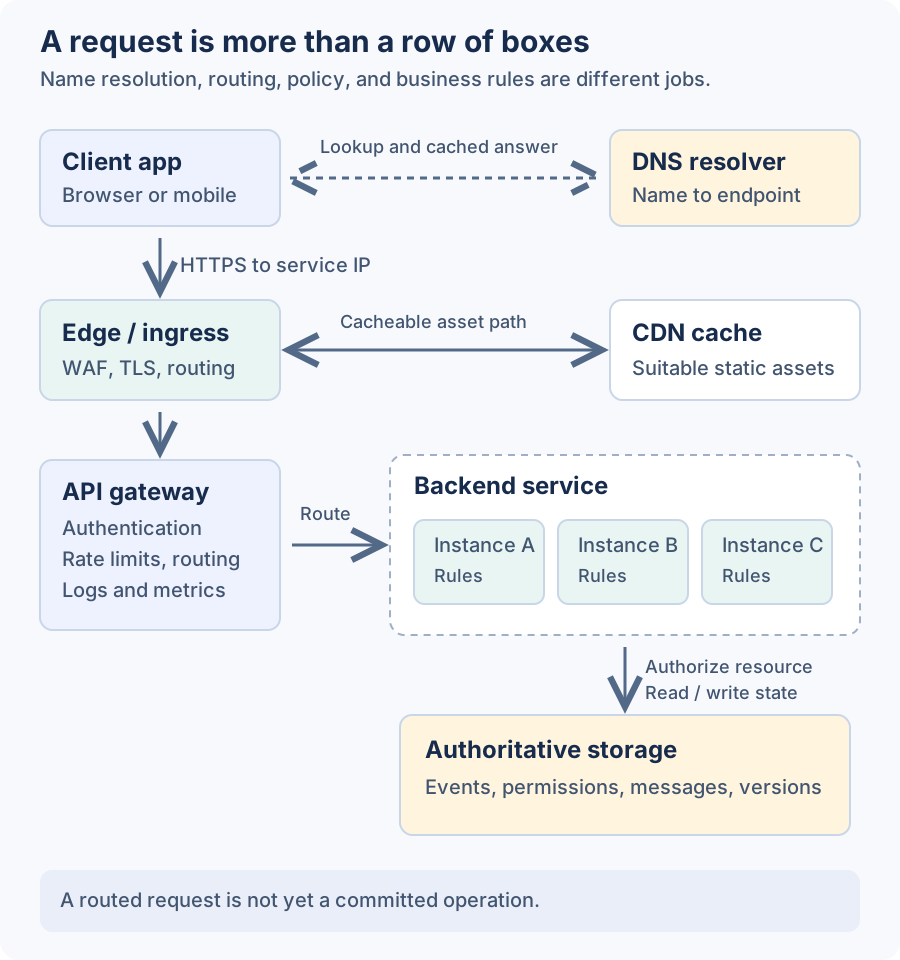
Logging in does not authorize every calendar read or conversation send. TLS may terminate at the edge and be re-established internally; define the trust boundary. The edge’s web application firewall (WAF) filters common malicious web traffic, not every application-level abuse case.
A service is a logical capability; an instance is one running copy. A modular monolith deploys capabilities together; microservices deploy them independently, adding network calls and distributed failure handling.
- Calendar: begin with event, permissions, and reminder modules in one application.
- Messaging: gateways may merit separate deployment because connections restart and scale differently from message processing. A gateway holds live connection state, so it is not stateless; it can still be replaceable if durable messages live elsewhere.
Make background work recoverable
A queue retains work for workers to process. A stream retains events for replay and independent consumers. Use Azure Service Bus, Amazon SQS, or RabbitMQ for jobs; Kafka, Azure Event Hubs, or Kinesis for retained event streams when needed.
The transactional outbox is a durable “work to publish” record committed in the same transaction as the business change. Without it, a crash between saving data and publishing work can leave a Calendar event without invitation work, or an accepted message without delivery work.
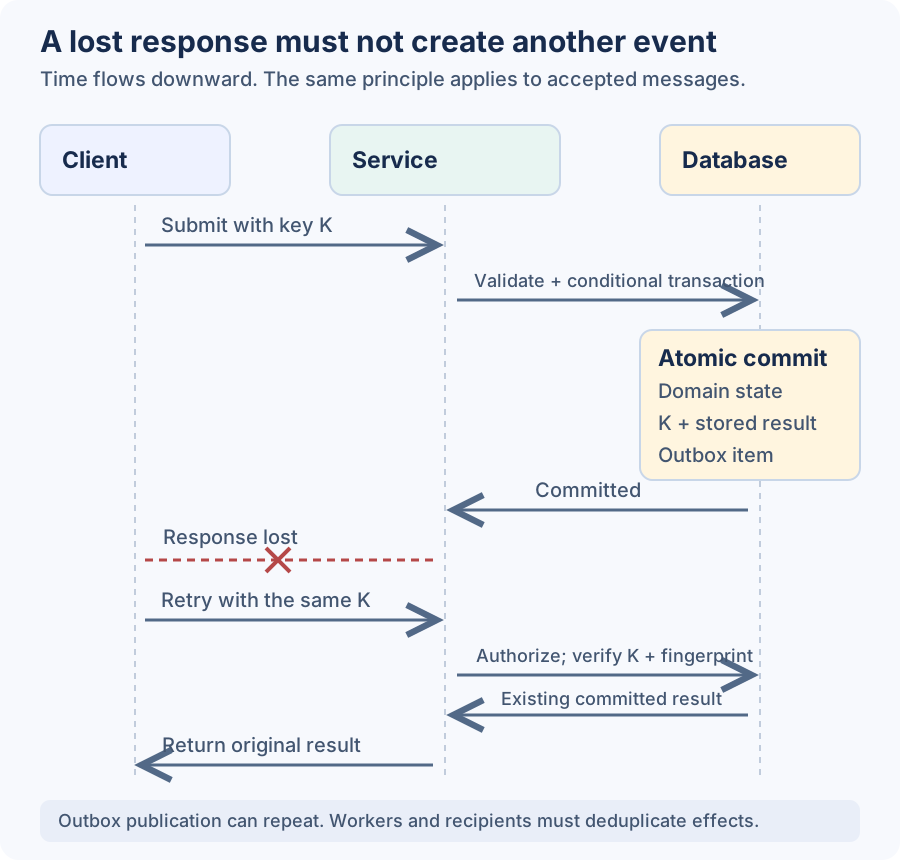
An outbox publisher can publish twice; workers must deduplicate. Ordering is separate: Calendar version 8 may arrive before version 7. Apply newer complete snapshots or rebuild; incremental changes require ordered processing or gap recovery. Messaging uses sequences, not arrival order. External email/push may still duplicate without provider idempotency.
Trace both complete designs
The diagrams show logical responsibilities, not fleets sized for Phase 3. Our launch baseline is one region, replaceable application instances, and SQL configured for the single-zone durability target. Regional recovery is a separate decision in Phase 7.
The conversation owner is a coordination role, not necessarily a separate service. In our SQL baseline, an ownership record maps a conversation to an instance and epoch (ownership generation). If A fails, a coordinated, atomic transfer gives B epoch 18 instead of 17. Storage checks the current epoch atomically with every authoritative write, rejecting A’s stale writes. B recovers committed sequence state; clients retry with stable IDs. This is fencing: it stops competing writers, but cannot recover unreplicated data after regional loss.
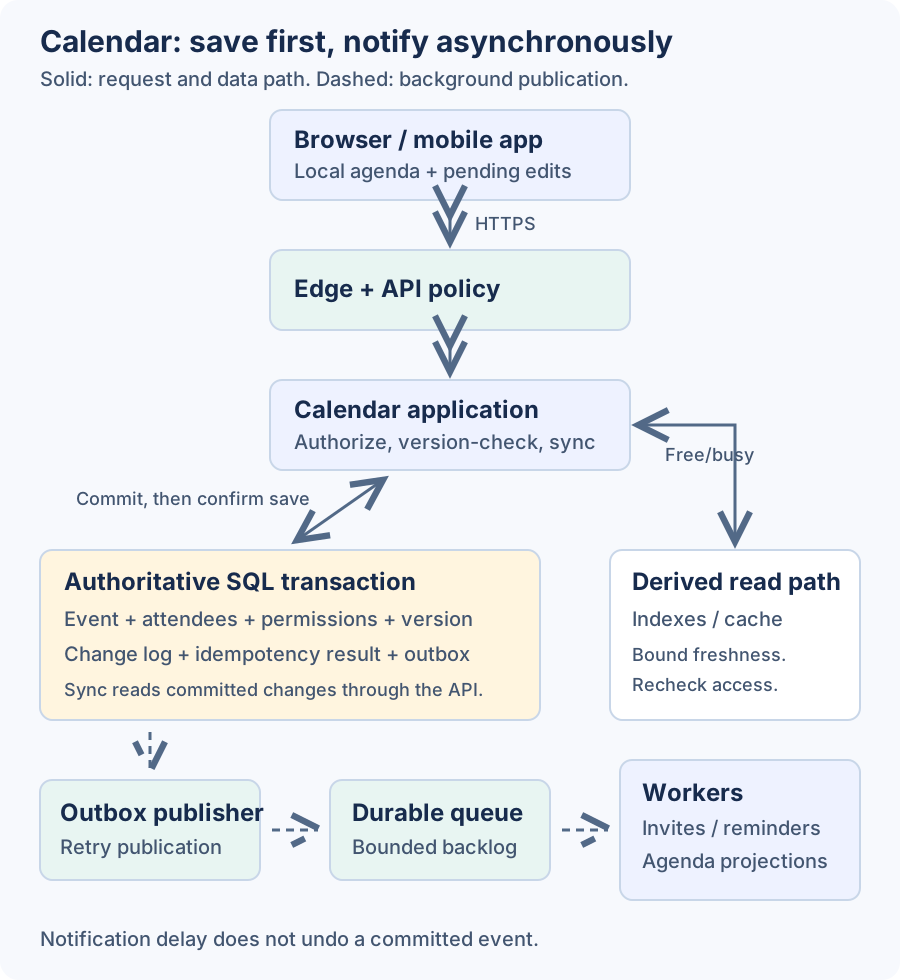
Calendar: authorize, recover matching retries, and version-check new edits; commit the event, attendees, change record, retry result, and outbox. Confirm after commit; publish independently. Schedule reminders durably, not with process timers, and recheck cancellation.
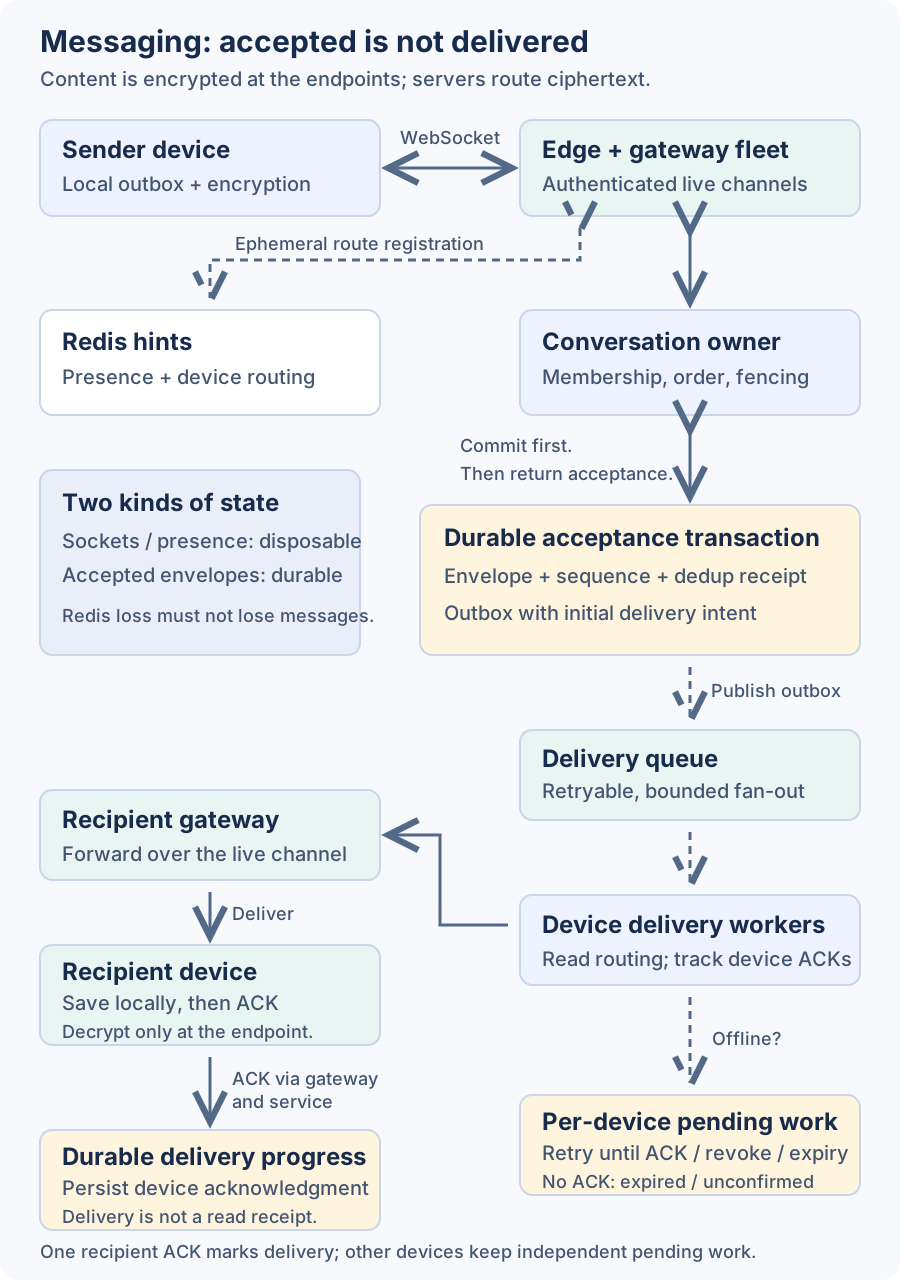
Messaging: the sender encrypts; one SQL acceptance transaction validates ownership and membership under concurrency control and commits the message, sequence, retry result, and outbox delivery intent. Workers deliver through gateways or retain pending work offline. Later recipient acknowledgments (ACKs) update durable delivery progress in separate transactions. Redis maps devices to gateways; these disposable hints are outside the acceptance transaction.
Decision depth: ownership must survive races. A stale membership-cache check cannot authorize acceptance. Retain retry records across time-bucket rollover; yesterday’s accepted operation must not become a new one today. Service-specific limits appear below.
Output: a trace of a write, read, retry, and background completion, with owners and commit boundaries identified.
Phase 6: Find and relieve bottlenecks
Measure the limiting resource before adding components. Different bottlenecks need different techniques.
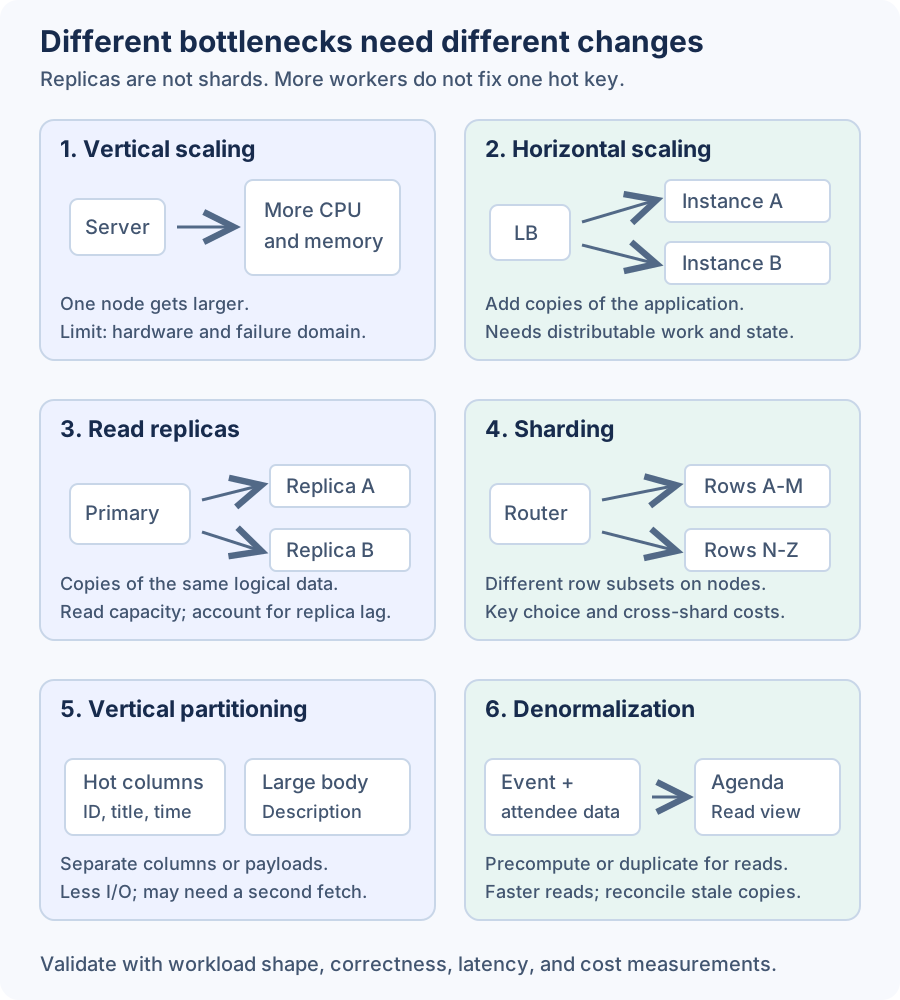
| Technique | What it changes | Calendar example | Messaging example |
|---|---|---|---|
| Vertical scaling | More CPU, memory, or I/O on one node; finite ceiling | Larger database instance | More gateway connection memory |
| Horizontal scaling | More instances; work must be distributable | More API instances | More gateways and delivery workers |
| Indexing | Extra lookup structure; costs writes and storage | Calendar/time index for range reads | Conversation/sequence lookup for replay |
| Read replicas | Additional copies serving suitable reads; may lag | Older agenda reads where permitted | Noncritical metadata reads, not stale authorization |
| Sharding | Distribute record subsets across database nodes | Calendar/tenant ownership key | Conversation-oriented key; hot groups remain a risk |
| Vertical partitioning | Separate fields/payloads, not larger machines | Keep long descriptions off list reads | Separate receipt metadata from large ciphertext payloads |
| Denormalization | Duplicate/precompute a read model; copies can lag | Attendee agenda and free/busy summaries | Conversation lists and unread summaries; plaintext previews stay client-side under E2EE |
Replication maintains copies; it is not sharding. Local table partitioning need not distribute work across machines. An index on event start time also needs correct interval-overlap logic: a long event may begin before the requested range.
Cache repeated reads; isolate large objects
A cache stores reusable results. In cache-aside, the application checks the cache, loads the database on a miss, and fills the cache. A time to live (TTL) limits how long an entry remains eligible.
Race example: A reads event version 5; B commits version 6 and invalidates the cache; A then fills it with version 5. A version label alone does not prevent stale reads. Coordinate invalidation with generation-checked fills: reject a fill if the cache generation changed since its read began. Bypass the cache when authoritative freshness is required; the database write and cache invalidation still are not one atomic operation.
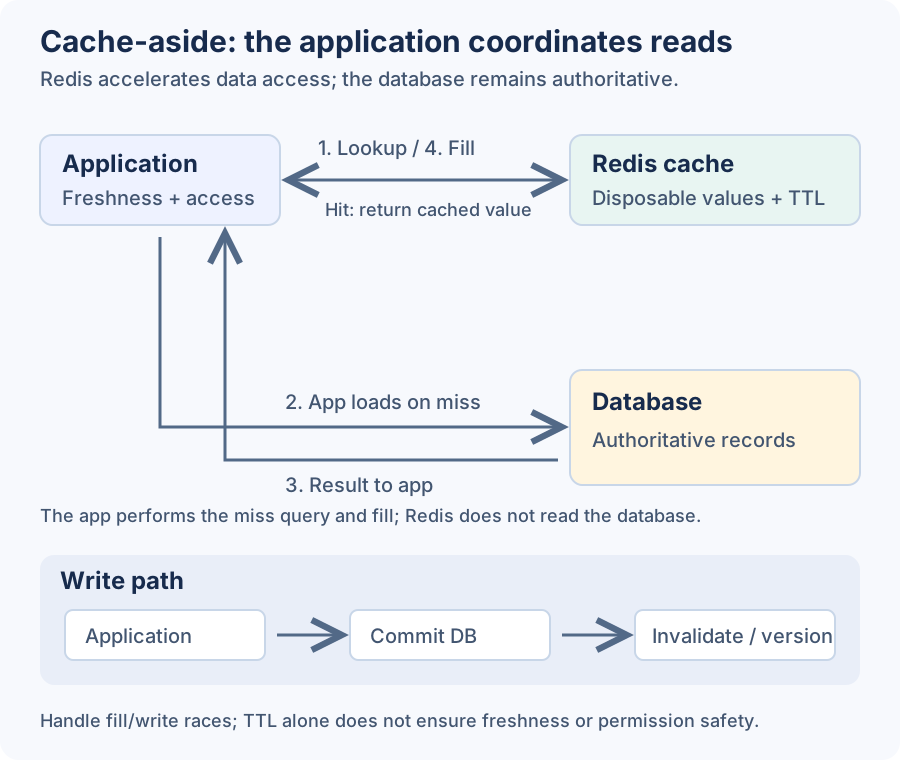
- Calendar: cache bounded free/busy results, but revalidate permissions and use authoritative checks for exclusive reservations.
- Messaging: cache routing and approximate presence, not the only copy of accepted messages. Heartbeats and expiry indicate likely connectivity, not certain availability.
Redis, Azure Managed Redis, and Amazon ElastiCache are options. A cache stampede occurs when many misses trigger the same expensive fetch: combine concurrent fills, stagger expirations, and bound database concurrency during a cache outage.
Blob/object storage, such as Azure Blob Storage or Amazon S3, holds large files. CDNs, such as Azure Front Door, CloudFront, or Cloudflare, cache suitable assets near users. Both apps can use a CDN for static UI files; private attachments need scoped access and deliberate cache rules. Messaging clients encrypt attachments before upload, then send the reference and key inside the encrypted message. Clean up abandoned uploads.
Bound fan-out, hotspots, and backlog
Calendar edits may create attendee updates and reminder jobs; messaging creates work per recipient device. Queues absorb bounded bursts, not unlimited sustained overload. Backpressure slows or rejects new work when downstream capacity is exhausted.
Measure queue age and per-key traffic, not only backlog count or average CPU. Delay Calendar invitations or drop typing updates before sacrificing core writes. If the durable path is full, return a retryable failure, not false success.
Decision depth: time buckets are not capacity guarantees. A conversation/time-bucket key groups a time range; it does not cap bytes, message count, or traffic. Retention needs expiry/deletion policy. One popular Calendar tenant or chat can still dominate a partition. Test hot keys, spikes, and mass reconnects; consider product limits before assuming more workers will fix serialized work. Large broadcasts may need delivery computed on read instead of per-recipient writes, changing latency and privacy.
Output: measured bottlenecks, targeted changes, and their new operating costs.
Phase 7: Design for failure and trust
Recover without inventing success
A single point of failure can stop a required workflow by itself. Failover moves responsibility to a replacement. Multiple instances do not help if all depend on the same unprotected database or exhausted connection pool.
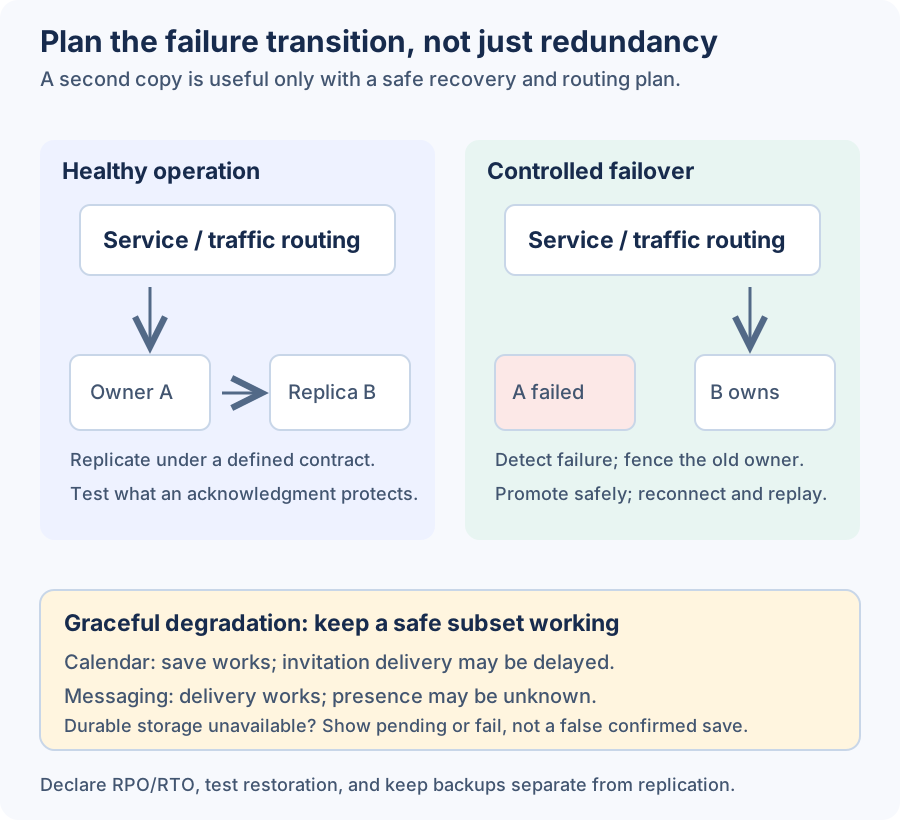
| Failure | Calendar behavior | Messaging behavior |
|---|---|---|
| Commit fails | Keep an explicit pending edit; do not confirm save | Retain the sender’s pending message and stable retry ID |
| Commit succeeds; response is lost | Retry the same key; return the saved result | Return the original acceptance receipt |
| Publisher/queue is unavailable | Outbox retains invitation work within safe limits | Outbox retains delivery work; stop accepting if backlog limits are reached |
| Worker runs twice | Deduplicate; account for external notification limits | Deduplicate messages and update receipts idempotently |
| Gateway fails | Reconnect and fetch missed changes | Reauthenticate, reconnect, and replay missing deliveries |
| Cache fails | Bound fallback reads or shed optional work | Presence can be unknown; durable replay must still work |
Use timeouts and capped retries with exponential backoff and jitter, a random delay that prevents synchronized retry storms. Circuit breakers temporarily stop calls to unhealthy dependencies; bulkheads isolate resource pools. Dead-letter queues hold failed work for investigation, alerts, and controlled replay.
For Calendar, isolate reminder failures from saves. For messaging, isolate typing and presence from acceptance. Deployments should drain connections where possible rather than force every client to reconnect simultaneously.
Restore the right state after disconnection
A cursor records synchronization progress. Calendar clients fetch a snapshot, then committed changes including deletions, and advance their cursor only after applying them. Snapshot creation and change capture must share a gap-free boundary. Expired/invalid cursors require full resync while preserving unsent local edits separately.
Messaging clients resume authorized delivery from durable progress. Do not advance a contiguous cursor past an unexplained gap. But explicitly handle server-confirmed expiry, deletion, or entries outside a device’s authorized history; otherwise replay can wait forever. An expired envelope cannot be recovered from a server that no longer retains it. Database TTL cleanup may lag, so enforce logical expiration when serving data.
Mobile push through APNs or Firebase Cloud Messaging (FCM) is a wake-up/change hint, not proof that either application retrieved or durably stored its updates.
Choose consistency and regional recovery deliberately
Replica freshness concerns whether a copy has caught up; transaction isolation concerns how concurrent transactions interact. Atomic writes do not guarantee fresh reads from an asynchronous replica. Calendar may route own-edit reads to an authoritative copy; messaging may serialize conversation writes while letting presence lag.
A network partition prevents groups of nodes from communicating. CAP says a partitioned system cannot guarantee both a single-copy, real-time-consistent view (linearizability) and availability of every operation at non-failing nodes. This technical availability is not the same as a monthly uptime percentage.
- Calendar: isolated regions must not both confirm an exclusive room reservation.
- Messaging: an isolated region must not create a competing conversation sequence.
- Both: explicitly stale reads or local pending work may remain useful.
PACELC adds that, even without a partition, stronger coordination can trade latency for consistency. Apply the trade-off per operation, not as a label for the whole product.
RPO (recovery point objective) is the tolerable time window of committed data loss; RTO (recovery time objective) is the restoration-time target. Single-zone durability does not imply regional durability. Asynchronous regional replication with a five-minute RPO cannot promise zero loss of all regionally acknowledged writes. Stronger cross-region commit guarantees add latency, coordination, and availability costs for both applications. Replication also copies mistakes: maintain backups and test restores.
Protect users at every boundary
Use authentication, resource-level authorization, tenant isolation, least privilege, credential rotation, and logs without private payloads. Encryption in transit protects network hops; encryption at rest protects stored media under its key-management model. End-to-end encryption (E2EE) keeps content-decryption capability at the endpoints.
- Calendar: distinguish owner, editor, reader, and free/busy-only access. Revoke cached access safely; cap invitation sending so event creation cannot become a spam service.
- Messaging: use reviewed encryption protocols, device identities, key verification, forward secrecy (protecting past messages if current keys are compromised), and defined membership/key changes. Removing Leo from routing lists alone is insufficient: the group protocol must exclude him from future key material and coordinate sending with the new membership state. This cannot erase plaintext already received. Server-side plaintext search/scanning conflicts with ordinary E2EE; backups and reports need privacy designs.
Rate limiting bounds caller activity. A token bucket allows bounded bursts with
replenishing capacity; a sliding window measures recent requests. Calendar free/busy
queries should cost more quota than cheap metadata reads; messaging needs send, group,
payload, and device limits. Combine these with block/report flows and abuse signals.
IP-only limits penalize users sharing a network. HTTP APIs can return 429; persistent
channels need an equivalent retry policy.
Decision depth: security changes the product surface. Calendar authorization affects cache keys and derived views. Messaging E2EE changes search, moderation, device recovery, and attachments. Neither is a feature that can safely be bolted on after data ownership and delivery contracts are fixed.
Output: tested failure/recovery behavior, access boundaries, and abuse controls.
Phase 8: Defend and evolve
Explain each choice as need, requirement, choice, alternative, cost, and validation.
- Calendar: preserving colleagues’ edits requires version checks. Choose optimistic concurrency over silent last-write-wins; accept conflict-resolution UX; measure failed saves and successful conflict recovery.
- Messaging: preserving accepted messages requires durable commitment before replying. Choose storage-backed acceptance over gateway-memory-only handling; accept write latency and recovery work; test acknowledged-message loss under gateway and zone failures.
Then evolve from evidence:
| Stage | Calendar | Messaging |
|---|---|---|
| MVP | Modular application, SQL, version checks, outbox, bounded sync | WebSocket-capable app, SQL, client pending work, small groups, E2EE, replay |
| Growth | Targeted caching, read optimization, dedicated reminder workers | Separate gateways, routing hints, delivery workers, partitioning if measured |
| Global | Regional ownership and explicit cross-owner sync/recovery | Conversation home regions, fenced failover, explicit cross-region durability |
Release gates: test lost responses, duplicates, out-of-order work, offline replay, zone failure, and peak load before exposure. Roll out to a small cohort first. Stop for any confirmed unauthorized exposure or acknowledged-write loss; pause on the defined 15-minute freshness breach or a pre-agreed acceptance/delivery SLO threshold. Roll back only when old code remains compatible with written data; otherwise disable the feature and reconcile. Assign an owner to each response.
Observe save/acceptance success, sync/delivery delay, overdue work, duplicates, and reconnect failures. Separate queue waiting from processing time; avoid private payloads in telemetry. Connect these to customer outcomes: successful scheduling without corrective rework, or confidence that a conversation reached its recipient.
Decision depth: price the actual work. Distinguish cheap Calendar reads from broad free/busy queries. Messaging cost per recipient-device delivery exposes amplification hidden by cost per submission. Include storage, replicated writes, egress, and always-on capacity. Managed services reduce operating work but add limits and dependency risk. If latency improves 30% while cost doubles, verify task-completion or satisfaction gains and opportunity cost; beating an already adequate latency target is not automatically product progress.
Output: an owned decision record, rollout plan, and measurable reasons to change it.
Technology reference: choose a coherent subset
Optional reference, not a shopping list. Wide tables scroll on smaller screens.
| Layer | Candidate technologies | Question to settle |
|---|---|---|
| Client and offline state | React, Swift, Kotlin; IndexedDB, SQLite/Room | Which actions remain pending? |
| DNS | Azure DNS, Amazon Route 53, Google Cloud DNS | How does caching affect failover? |
| Edge, reverse proxy, load balancing | Azure Front Door/Application Gateway, AWS ALB/NLB, NGINX, Envoy | Draining, TLS termination, caching? |
| API policy | Azure API Management, Amazon API Gateway, Apigee, Kong | Which checks remain application-owned? |
| API implementation | ASP.NET Core, Spring Boot, FastAPI; Apollo Server, Hot Chocolate | Which interaction pattern fits? |
| Live channels | WebSocket servers, Azure Web PubSub, Azure SignalR Service | Who implements reconnect/replay? |
| Application compute | Azure App Service/Container Apps, AWS ECS; Go, Node.js | Are independent deployments justified? |
| SQL | Azure SQL Database, PostgreSQL, MySQL, Amazon Aurora | Transaction scope and isolation? |
| NoSQL | Azure Cosmos DB, Amazon DynamoDB, MongoDB, Cassandra, ScyllaDB | Keys, transaction scope, hotspots? |
| Cache | Redis, Azure Managed Redis, Amazon ElastiCache, Memcached | Stale or unavailable behavior? |
| Jobs, streams, scheduling | Service Bus, SQS, RabbitMQ; Kafka, Event Hubs, Kinesis; Temporal, Durable Functions | Workers, replay, or timers? |
| Objects and CDN | Azure Blob Storage, Amazon S3, Google Cloud Storage; Front Door, CloudFront, Cloudflare | Authorization and expiry? |
| Identity and secrets | OpenID Connect; Entra External ID, Cognito, Auth0; Key Vault, AWS KMS | Revocation and key rotation? |
| Search, if needed | Azure AI Search, OpenSearch, Elasticsearch | Freshness, permissions, plaintext availability? |
| Notifications | APNs, FCM, Azure Notification Hubs | Hint or application acknowledgment? |
| Observability and analytics | OpenTelemetry, Application Insights, Prometheus/Grafana; Microsoft Fabric, BigQuery | Outcomes without privacy/serving-path risk? |
Optional DynamoDB detail: combine expected-sequence/epoch conditions with the metadata
Update; a transaction cannot condition-check and update the same item separately.
Native client-token idempotency lasts 10 minutes; longer retries require application
deduplication records. These service limits do not change the user-facing retry promise.
Apply the framework to your next product
Apply the framework to your workflow: payments emphasize ledger correctness and reconciliation; commerce, inventory reservations; analytics, freshness, throughput, and cost.
- What does the user do, and what exactly does success promise?
- Which data is authoritative, and where does the operation commit?
- What work multiplies with users, recipients, or data size?
- What happens after a timeout, retry, stale read, or regional failure?
- Which measurement justifies the next layer of complexity?
Change one constraint: ten times the load, half the budget, or stricter privacy. Explain which decisions change, which stay, and why.
References and further reading
- Google Calendar: recurrence, incremental sync, and push notifications.
- Meta Engineering: WhatsApp multi-device design (historical architecture context, not a current product-limit specification).
- Azure Cosmos DB: partitioning and transactional batches.
- Amazon DynamoDB: transaction behavior, limits, and idempotency.
- Azure Architecture Center: transactional outbox and competing consumers.
Note: This blog post was written with assistance from AI